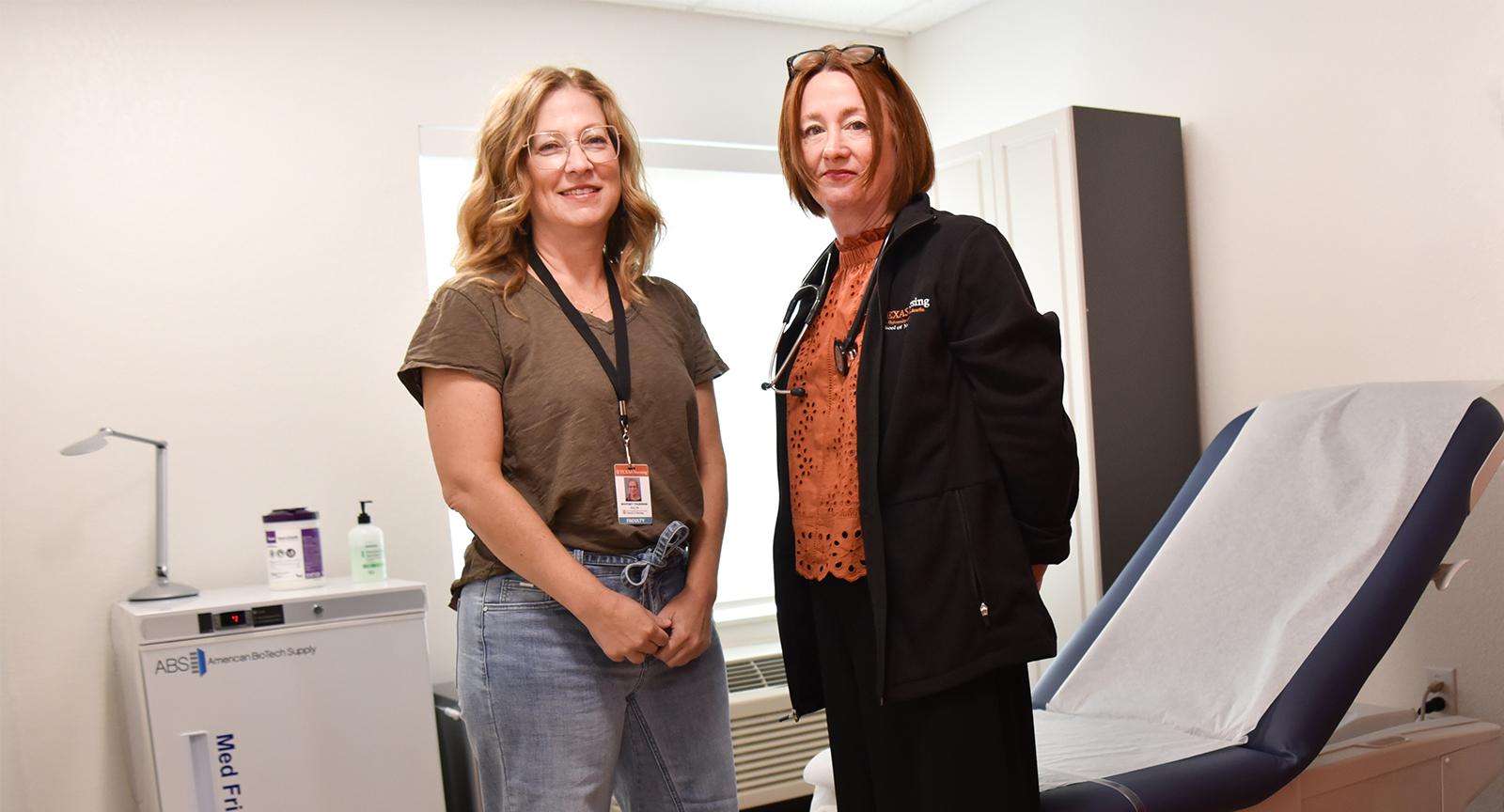
When leaders from the School of Nursing learned there was a critical need for health care services at a new permanent supportive housing site in Austin for older adults exiting homelessness, they stepped up.
Now, more than a year later, the onsite health clinic at Pecan Gardens, operated by the School of Nursing, has become a cornerstone of care for residents aged 55 and older who are disabled and working to overcome chronic homelessness.
Located in a former hotel converted into 78 fully furnished studio apartments, Pecan Gardens offers more than just a roof overhead. Operated by Family Eldercare with the Austin Housing Finance Corporation, it provides wraparound services—case management, health assessments, independent living skills and an onsite food pantry—to support residents’ long-term housing success. Residents connect through the Ending Community Homelessness Coalition and pay no more than 30 percent of their income in rent, with all utilities covered.
By embedding nurse-led health services directly into the housing community, the School of Nursing is helping improve access to care, stability and overall well-being for one of Austin’s most vulnerable populations.
Meeting the Need
The clinic eliminates the barrier of transportation, providing direct access to health care within the residence.
Stephanie Lowe, permanent supportive housing program manager for Family Eldercare/Pecan Gardens, said the clinic was created to provide coordinated, comprehensive care through an interdisciplinary team.
By providing on-site care, the clinic bridges access gaps and promotes seamless coordination among providers, case managers and support services for holistic resident health.
“Having the School of Nursing provide a clinic for the residents of Family Eldercare/Pecan Gardens is a significant enhancement to the quality of care and well-being of our community,” Lowe added. “This partnership ensures that residents have direct access to essential medical services, fostering improved health outcomes through preventive care, chronic disease management and health education. It also means that residents can receive guidance on medication and treatment management, empowering them to take control of their health with professional support.”
Elizabeth Racine, MSN, APRN, FNP-C, a nurse practitioner at Pecan Gardens, says the clinic embodies the School of Nursing’s commitment to community care, health equity and hands-on student training, blending nursing practice with social determinants of health.
Integrated Care in a Residential Setting
Unlike other School of Nursing clinics, Racine said Pecan Gardens serves a high-risk, aging residential population, combining health care with supportive services to ensure continuity of care.
The clinic provides residents with primary care, chronic disease management, preventive screenings, medication management, social services and mental health support through Blue Bonnet Community Services, while partnering with Family Eldercare for a comprehensive approach to medical and social needs.
“Working at Pecan Gardens has provided an invaluable experience in primary care, interdisciplinary collaboration and understanding the real-world challenges faced by older previously unhoused adults,” Racine added. “One example of the clinic’s impact was a patient who struggled with unmanaged diabetes due to transportation barriers. With regular access to care, education and medication management, we were able to stabilize her condition, reducing hospital visits and improving her overall well-being.”
Learning Opportunities for All
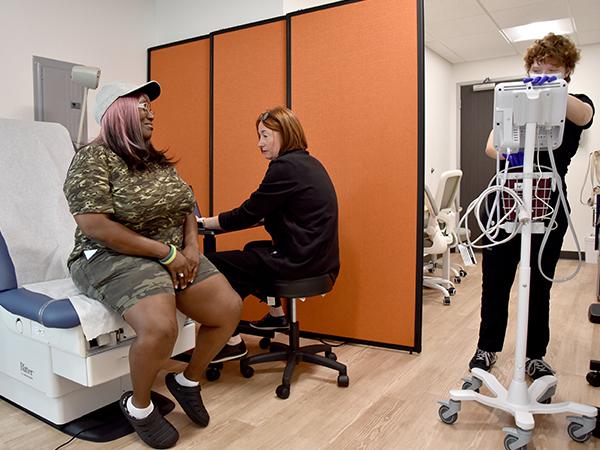
At the clinic, nursing students gain hands-on experience in assessments, education, care coordination and research, applying classroom knowledge to real-world settings while supporting residents’ health and preparing for careers in community and geriatric care.
“The clinic genuinely seems to be making a difference for the patients we serve,” said Lucia Collins, a BSN student intern at the clinic. “We have been able to see the same patients over time and build relationships and trust with them. It has been very gratifying to see the improvement in their health and management of their conditions. Working at Pecan Gardens has been a great experience for me and a huge benefit to my nursing education.”
Lowe shared that the residents have expressed strong appreciation for the clinic and the care provided by the School of Nursing.
Racine said residents value the convenient, personalized care and guidance, feeling more confident in managing their health. Though some request help with paperwork or transportation, overall feedback has been very positive.
“I really love that you have a clinic here,” said Jane Turner Roberts, a resident at Pecan Gardens. “It is so convenient, and I don’t have to travel. You are so helpful.”
Data-Driven Change
Whitney Thurman, PhD ’18, RN, assistant professor at the School of Nursing, is studying the health and functional needs of older adults transitioning from chronic homelessness into permanent supportive housing, funded by the Gordon and Betty Moore Foundation.
About 50 Pecan Gardens residents participate in Thurman’s yearlong study tracking health, care use and function. Data collected quarterly show high rates of chronic conditions, including hypertension, diabetes, COPD and mobility impairments.
“One of the things we’re seeing is a high level of functional impairment,” Thurman said. “Many residents struggle with basic mobility—things like standing up from a chair. Cognitive impairment is another area we’re starting to explore more. We suspect it’s more prevalent in this population than is currently recognized. The goal is to use this data to inform policies and programs that ensure people don’t just get housed but that they can stay housed and thrive.”
Additionally, many residents face challenges in adjusting to their new housing due to disrupted routines and the loss of familiar community resources.
“Moving into housing is not a simple fix,” Thurman added. “People are still carrying trauma, they’re disconnected from their previous support systems, and they have to learn to navigate a completely different way of living. We often think of housing as the end goal, but in reality, it’s just the beginning of another difficult transition.”
Lowe shared that Thurman and her team have been a helpful resource and provide crucial support to the residents.
“Through their research and assessments, they not only gathered important data but also identified unexpected barriers that our residents face,” Lowe said. “Their insights have helped us better understand the challenges within our community, allowing us to enhance the quality of support services we provide.”
While conducting the study, Thurman has found that the residents are eager to participate, often extending interviews beyond their scheduled time.
“Almost everyone we ask wants to participate,” Thurman said. “Many of them just want someone to talk to. The surveys are designed to take 15 minutes, but they often turn into hour-long conversations because people have so much to share. I’ve had participants tell me, ‘I just want to help other people who are going through this.’”
Thurman’s research aims to inform policies and programs that help older adults maintain stable housing, prevent homelessness recurrence, reduce unnecessary nursing home placements and improve overall quality of life.
Lowe hopes residents will gain confidence and self-sufficiency in managing their health, developing skills for medication management, regular monitoring, and proactive self-care through education and support from the clinic.
“We are incredibly pleased and grateful to have the School of Nursing providing high-quality, compassionate care to our residents at Pecan Gardens,” Lowe said. “Their expertise and dedication to community health have been invaluable in addressing gaps in care, offering essential medical services and educating residents on managing their health more effectively.”
Lowe said the partnership has improved access to care and given residents the knowledge and tools to enhance their well-being and maintain independence.
“We look forward to continuing this collaboration and expanding the services available to ensure our residents receive the highest standard of care,” she said.