
Merci Paulhill had high hopes for her Graduate Archer Fellowship in Washington, D.C., and she wasn’t disappointed.
“Washington has been an adventure, honestly,” said Paulhill, who graduated from the School of Nursing with a BSN in 2022. “I had my expectations going in. I knew things move fast in the heart of our nation. Now, having lived here for some time, I’m finally getting a feel for how the city operates both logistically and legislatively.”
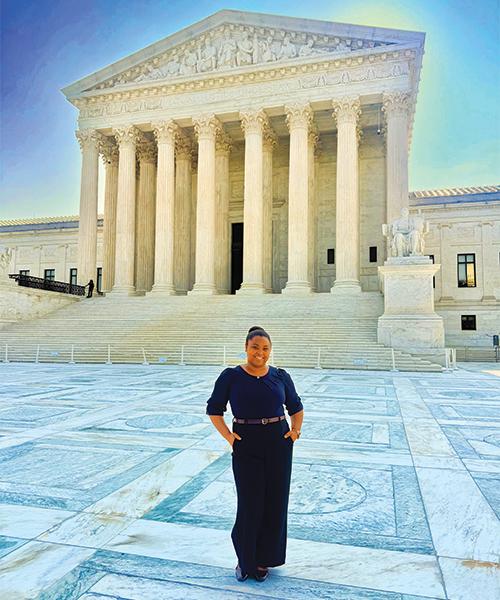
Paulhill, from Conroe, is a third-year student in the PhD program, expecting to graduate in 2028. Her dissertation is titled, “Adoption and Adherence Behaviors towards Treatment Interventions in Adults with Interstitial Lung Disease,” which was inspired by a close family member with the same illness.
The Graduate Archer Fellowship is a highly selective UT System-wide program open to students across disciplines. Fellows arrive with varying levels of public-policy experience but share an interest in understanding the policymaking process through the lens of their academic fields. Students live and study in Washington, D.C., gaining firsthand exposure to federal policymaking and engaging directly with legislators and policy professionals.
“We take classes on policy development and history, as well as participate in internships with organizations of our choosing that closely align with what we’re studying in our home institutions,” said Paulhill, who worked with the American Nurses Association (ANA). She was one of only two nurses selected for the Archer Fellowship this year and the only fellow from the School of Nursing.
“I see this as an opportunity for nurses to enter the policy arena and recognize that we have valuable expertise and stories to share,” she said. “My goal is to take the experiences I’ve gained here, bring them back to my institution, and encourage other nurses to get involved in policy and government advocacy, as well.”
But this summer wasn’t only about work. Paulhill also experienced Washington’s history beyond the classroom.
“D.C. is a beautiful city with such a deep history that’s important to acknowledge,” Paulhill said.
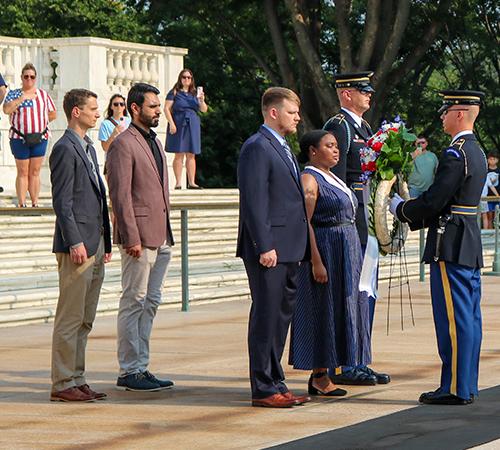
During the final week of her fellowship, her peers selected her to lay a wreath at the Tomb of the Unknown Soldier at Arlington National Cemetery.
While in Washington, Paulhill met with representatives from the offices of U.S. Senators Ted Cruz and John Cornyn, as well as Rep. Greg Casar. She also met Rep. Lauren Underwood of Illinois, herself a registered nurse.
“Even though she’s involved in numerous legislative and advocacy efforts, she has never forgotten her nursing roots and has continued to champion the voice nurses bring to policymaking,” Paulhill said of Underwood. “She has great ideas of how we, as a discipline, can establish a stronger presence in government. Her journey is a great source of inspiration for me.”
Some of the issues that Paulhill discussed with legislators included workplace violence prevention against nurses and how nursing’s classification as a professional degree impacts student loans.
“Recognizing that there’s a nursing workforce shortage, we have to consider how financial barriers that prevent students from completing their programs also prevent them from entering the workforce,” she said.
Paulhill has worked as a registered nurse in the operating room since graduating. She was curious why hospitals have certain procedures in place in their operation, which is one reason why she wanted to do the fellowship.
“I wanted to peel back the curtain and get my PhD to become a source of knowledge and help inform the work being done while I continued serving as a staff nurse,” she said.
Getting her PhD will open many avenues for Paulhill as her career advances – such as teaching or research – or even non-academic routes.
“Policy is one of those nonacademic routes that I’ve really grown to enjoy,” she said. “I think it’s very difficult to enter, and it’s a path that’s still lightly trodden. That’s why I’m grateful whenever I find a health policy nurse I can look to for guidance. At the same time, I’ve been fortunate thus far to have a strong support system of professors at the school who have helped me develop the foundation to become a thoughtful and rigorous researcher.”
Does that mean we could be seeing the future Congresswoman Paulhill?
“Congresswoman Paulhill. Now, wouldn’t that be something,” she said with a chuckle.