
Few leaders leave an impact so enduring that their influence is still felt decades after they step down. Dean Emerita Billye J. Brown, EdD, RN, FAAN, was one of those few—her fingerprints are on every degree earned, every research breakthrough and every student who has walked the halls of the School of Nursing.
Brown, who passed away on June 24, 2025—just months shy of her 100th birthday on October 29—left behind a legacy that shaped not only a school but the future of nursing education.
Determined and committed to excellence, she served as the founding dean of the School of Nursing, holding the role from 1972 until her retirement in 1989.
“Billye Brown was a visionary leader whose impact on nursing education continues to shape our profession today,” said Dean Eun-Ok Im, PhD, MPH, RN, CNS, FAAN. “Her commitment to academic excellence, innovation and student success set a standard we still strive to uphold at the School of Nursing. We are proud to carry forward her in her honor.”
A Texas Nurse’s Path to Leadership
Born and raised in Damascus, Arkansas, Brown’s journey into nursing began with a Bachelor of Science in Nursing from UT Medical Branch in Galveston, followed by a Master of Science in Nursing from St. Louis University and a Doctor of Education from Baylor University. But her influence would be defined not by degrees but by how she used them to elevate the profession she loved.
Barbra Mann Wall, PhD, BSN ’71, RN, FAAN, and Brown co-authored a book about the history of the School of Nursing titled Through the Eyes of Nursing.
“Billye was head of the School of Nursing when I graduated in 1971,” said Wall. “I remember her as Miss Brown, before she obtained her EdD. I didn’t realize that, as she was leading this challenging new program, she was also working on a doctorate, along with many other UT Nursing faculty at the time. When we began writing our book together, she requested I call her ‘Billye.’ We became great friends and writing partners.”
In the 1970s, Brown played a key role in establishing the School of Nursing in Austin and in helping lead the broader University of Texas System School of Nursing (UTSSN). This multi-campus system included nursing schools in Austin, El Paso, Fort Worth, Galveston, San Antonio and Houston. She was appointed as associate dean of the UTSSN in Austin in 1967. Between 1968 and 1973, enrollment in the Austin campus increased by 350 percent.
In 1976, the UTSSN underwent a major restructuring when the Board of Regents voted to decentralize the system, placing each campus under the administration of its nearest health science center or academic institution. According to Wall, the decision marked a challenging and emotional transition for faculty across the campuses. They had poured their energy into building a nurse-led system, which Wall described as “Florence Nightingale’s dream: to have nurses leading in health care.” Following the decentralization of the UT System’s multi-campus nursing program, Brown was selected to lead the newly independent School of Nursing at UT Austin.
As dean, she oversaw the development of undergraduate and graduate programs, established a growing research enterprise and launched a continuing education program that extended the School’s impact well beyond campus. She led the launch of the School’s PhD program and the Alternate Entry Nursing Program, which offers a pathway for people with a degree in another field to become nurses. In addition, she established the Alumni Association and Sigma Theta Tau International Honor Society of Nursing chapter and helped secure a permanent home for the School on Red River Street—a facility that signaled the School’s future as a national leader in nursing research and education.
Her tenure saw tremendous growth in enrollment, research and reputation. Her forward-thinking leadership helped position the School as one of the nation’s most respected nursing programs. By the time she retired in 1989, the School was ranked sixth in the nation.
“As the inaugural dean, she had a strong vision for both the profession of nursing and how the School of Nursing, with its unique strengths as part of a public flagship university, could contribute to moving the profession forward,” said former Dean Alexa Stuifbergen, PhD, RN, FAAN, James R. Dougherty Jr. Centennial Professor. “She knew this wouldn’t happen overnight and she addressed her work from multiple perspectives. At the individual level, she listened, encouraged and challenged nurses to improve their education and then lead and influence others. At the larger structural level, she made a difference through her leadership in national and international nursing organizations. She saw opportunities and was willing to do the slow, painstaking work to support change and improvement.”
Leading Nursing’s Educational Revolution
The School of Nursing was established during a time of historic change in nursing education. Across the country, the model was shifting from hospital-based diploma programs to baccalaureate degrees offered by universities. Brown was at the forefront of this evolution.
According to Wall, the 1963 Surgeon General’s report, Toward Quality in Nursing, called for a dramatic expansion of the nursing workforce, including a significant increase in the number of baccalaureate-prepared nurses. Backed by strong political support from President Lyndon B. Johnson and the U.S. Congress, that vision began to materialize with the passage of the Nurse Training Act of 1964, which allocated millions of dollars to strengthen college-based nursing programs.
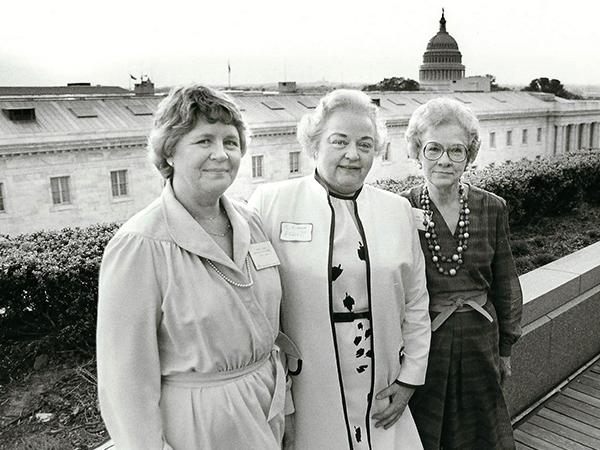
Brown was part of a pioneering generation of nurses who advocated for baccalaureate education independent of the hospital system. With new federal resources in place, their efforts took root, beginning in Galveston and marking the start of a new, academically-focused era in nursing education.
“Nursing shortages were not new, but what was new was public and private coalitions willing to do something about it,” Wall said.
Brown was one of those doing something.
She was known for her focus on building powerful partnerships. She built strategic coalitions with University leadership, including the president and Frank Erwin, then chair of the Board of Regents, as well as with clinical partners and community leaders.
She was a key figure in the movement to secure federal funding for college-based nursing programs—resources that helped bring her vision for the School of Nursing to life. And her vision extended far beyond the classroom. She hired faculty who would go on to shape the research endeavor of the School, including Dolores Sands, who would later become dean.
Before her retirement, Brown helped establish the School’s first research center—the Center for Health Care Research and Evaluation—laying the groundwork for the thriving research initiatives Texas Nursing is known for today.
A Lifelong Mentor
“For fifty years, Billye Brown has inspired me, first as my dean, and later as my mentor and my friend,” said Norine Yukon, BSN ’78. “Even in the last years of her life, Billye delighted in hearing what I was working on, and she was enthusiastic and generous with her guidance and opinions. Billye Brown made a deep and consequential impact in my life, and her contributions to health care education and nursing empowerment have no doubt rippled throughout the world.”
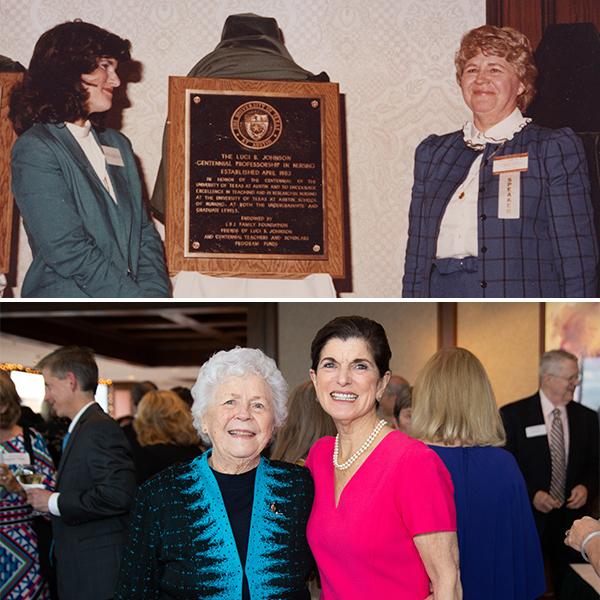
One of her most enduring alliances was with Luci Baines Johnson, a partnership that continues to have a lasting impact.
Luci Baines Johnson, daughter of President Lyndon B. Johnson and Lady Bird Johnson, has been a longtime friend and generous supporter of the School of Nursing. Her advocacy for the profession and her philanthropic commitment have strengthened the School’s ability to prepare future nurses and advance health care. Through her connection with Dean Emerita Billye J. Brown, Johnson was named an honorary member of Sigma Theta Tau, reflecting her enduring relationship with the School and its mission.
“Billye was my mentor and my friend for 55 years,” Johnson said. “Because of Billye, I got to testify in Congress for nurse practitioner programs, be an honorary member of her beloved Sigma Theta Tau, work for the National League for Nursing and this fall, have the penultimate of honors as an honorary fellow of the American Academy of Nursing.
“Everyone who knew Billye knew her blood ran burnt orange,” Johnson continued. “I witnessed the level of her sacrifice when she commuted regularly to Baylor to pursue her doctorate just because she felt UT deserved for its dean to have the highest level of education.”
Whether building relationships across campus or with influential allies, Brown had a unique gift for making others believe in her vision.
Describing her life as blessed with a “Billye trifecta,” Ferne Kyba, PhD, MSN ’76, School of Nursing advisory council member, earned her MSN under the leadership of Billye, later joined the School of Nursing faculty, and ultimately came full circle by serving on the advisory council.
“In each of these roles, Billye served as a valued mentor and guide,” Kyba said. “During those 50 years, she always exuded kindness, warmth, compassion and genuine caring with a keen memory for details about former students, colleagues and events. Her ability to focus just on you and your needs at that moment amazed.”
Her leadership reached far beyond the Forty Acres. Brown served as president of the American Association of Colleges of Nursing, the Texas Nurses Association and Sigma Theta Tau International. She also contributed as assistant editor of the Journal of Professional Nursing and held multiple national leadership roles.
In 1984, she was inducted into the American Academy of Nursing (AAN), and in 2010, she was named an AAN Living Legend—one of the highest honors in the field.
Even after retirement, Brown never stopped giving back. She continued to support the School financially, mentored the next generation of nurse leaders and showed up—again and again—as a guiding presence at School events. Her influence didn’t fade; it deepened.
“Her greatest influence on me personally was seeing how she led and influenced through her connecting with and valuing every person she knew,” Stuifbergen said. “She recognized that each person had different gifts and would contribute in different ways, and after she retired from the dean’s position, she was a master at helping connect alumni and others to opportunities. She valued how our alumni contributed in multiple ways—from excellence in clinical practice to academic leadership at large and small schools of nursing to leadership at the National Institutes of Health. She amazingly never seemed to forget a name no matter how many years it had been.”
Vision for the Future
Brown’s contribution to the School of Nursing lives on in the work of the thousands of students, faculty and alumni who carry forward her values of service, education and innovation.
“We all will remember her as the founding dean of the School of Nursing, mentor, friend and philanthropist,” Wall said. “Today, with the leadership from Deans Sands and Stuifbergen—and continuing with Dean Im—the School of Nursing has made huge contributions to nursing and many people throughout the state, nation and world; but Billye’s leadership started it.”
Brown’s family has also felt the impact of her many contributions to nursing.
“Losing my aunt, Billye J. Brown, leaves behind more than just memories—it leaves a legacy,” said Brown’s nephew Dan Dipert. “Billye was a person whose strength, integrity, compassion and mentorship touched everyone she met. Her dedication to family and the School of Nursing was unwavering.
“Whether through quiet acts of kindness or bold steps of leadership, Billye left an imprint on the world of nursing that time will not erase,” he continued. “Her legacy is one of resilience, generosity and love—a powerful reminder that one life, lived with conviction and purpose, can inspire many.”
Her leadership transformed an ambitious idea into a thriving institution, and her influence still resonates through every hallway, classroom and clinic that bears the Texas Nursing name.
Billye J. Brown built more than a school—she built a future.