
Nurse leadership goes beyond managing teams; it shapes the future of health care. Nurse leaders advocate for patients, influence policy, drive innovation and improve systems. They navigate complexity, empower teams and champion positive change. As health care grows more person-centered, the need for skilled, compassionate nurse leaders is greater than ever.
Cultivating nurse leadership is at the heart of the School of Nursing’s mission. Through a comprehensive and dynamic curriculum, real-world clinical experiences and strong mentorship, the School of Nursing prepares students to take on leadership roles that extend far beyond the traditional bedside care.
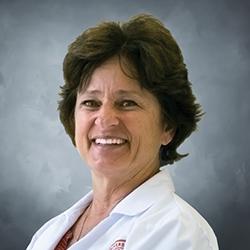
“We believe that leadership starts on day one,” said Ana Todd, PhD, RN, clinical associate professor. “At the School of Nursing, we assume our students are future leaders—and we treat them as such.”
Todd believes a strong nurse leader is both attuned to their immediate environment and aware of the broader health care system.
This systems-level perspective is essential for effective leadership. Equally important are interpersonal skills—being open to feedback, managing conflict, listening actively and staying engaged in the profession through advocacy or organizational involvement.
One of the ways the School of Nursing prepares students to become future nurse leaders is through its Honors Program.
Led by Todd, the program supports high-achieving students in nursing science and leadership, emphasizing research, critical thinking and professional development to prepare them to lead and innovate in health care.
Honors students collaborate with faculty mentors, pursue hands-on learning and present research at conferences. They receive personalized advising, take specialized coursework and develop leadership skills that strengthen their eligibility for scholarships and professional opportunities.
Combining Clinical Expertise with Business Insight

Myles Johnson’s path to nursing is shaped by personal experience and purpose. Inspired by his mother, an ICU nurse and caring for his grandmother with dementia, he pursues a health care reform and innovation minor at UT Austin’s McCombs School of Business alongside a BSN in the Nursing Honors Program—reflecting his dedication to nursing and health care’s broader landscape.
His passion for research led him to a project focusing on pain management during childbirth. Johnson’s research explores various pain management methods, such as epidurals, nitrous oxide and patient-controlled analgesia pumps, with a focus on patient satisfaction.
“Research is so important in nursing because it allows us to improve practices and enhance patient care,” Johnson said. “I’ve learned how to critically analyze studies and figure out how to apply evidence-based practices in real-life situations.”
Johnson’s minor gives him insight into health care administration. He focuses on how evidence-based practice guides clinical decisions and how financial factors, like insurance and billing, affect patient care. By blending nursing with business knowledge, he aims to bridge clinical practice and operational challenges in health care systems.
“I never really saw the connection at first, but my business minor has really opened my eyes to the administrative side of health care,” he added. “I’ve learned about the challenges the health care system faces, like cost and access, and I think it’s important to understand how those things affect patient care.”
Johnson also recently served as president of the ATX Nursing Students’ Association, where he worked to strengthen connections within the nursing student community while also promoting opportunities for leadership development and professional growth.
Developing Leadership Skills Through Coursework and Specialized Programs
At the School of Nursing, students develop leadership skills through hands-on experiences and a strong focus on advocacy. One key opportunity is the oral testimony project, where students research public health issues, receive advocacy training and deliver mock legislative testimonies. Leadership development also includes a required course with professional meeting attendance and peer mentorship, with leadership principles woven throughout the curriculum.
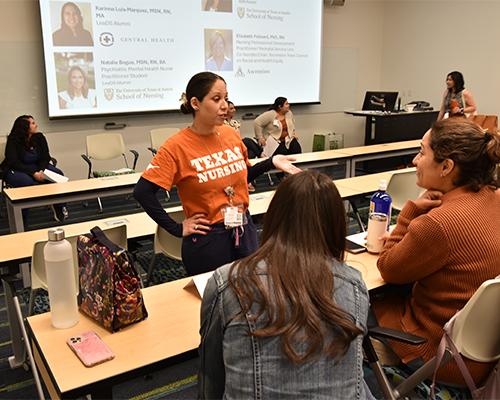
The Leadership in Diverse Settings (LeaDS) concentration within the Alternate Entry Master of Science in Nursing (AE-MSN) and MSN programs prepares nurses to lead across health care, education and community settings. The curriculum emphasizes skills in clinical practice, advocacy, resource management, communication and organizational change. Through focused coursework and a capstone project, graduates are equipped to drive innovation and impact in complex health care systems.
The program combines rigorous coursework and real-world experiences to prepare students as nurse leaders, educators and advocates. Capstone projects improve patient care, while partnerships enhance learning and system impact. Leadership develops through classroom learning and clinical practice, where students lead quality improvement projects under faculty and community mentorship, actively applying their skills.
“LeaDS is designed to be a catalyst for long-term career growth, particularly for nurses aspiring to leadership or educational roles,” said LeaDS Program Director Janice Hernandez, DNP, APRN, FNP-C. “By equipping students with advanced skills in project management, systems thinking and change leadership, the program prepares graduates to step confidently into roles such as nurse managers and clinical leaders.”
She emphasized the program’s focus on evidence-based practice, mentorship and teaching strategies that prepare students for nursing education roles. Through hands-on projects, community engagement and leadership development, students gain advocacy and policy experience, opening pathways to careers in public health, nonprofit leadership and health care consulting. The program fosters lifelong learning and prepares graduates to lead and innovate in health care.
“This program is more than a degree—it’s a movement,” Hernandez said. “It equips nurses with the tools, mindset and mentorship to lead transformative change in health care and beyond. And it lives out our University motto: ‘What starts here changes the world.’”
A Passion for Research, Leadership and Service

Spring 2025 BSN Honors graduate Galilea Dupree made a strong impact through her research, leadership and service. She contributed to caregiver science research, served as a peer mentor and worked on mindfulness interventions and pediatric epilepsy—experiences that will inform her future nursing practice.
“Research was one of the most rewarding aspects of my education at UT Austin,” Dupree said. “It allowed me to dive deep into topics that I’m passionate about particularly in nursing and mindfulness interventions, and contribute to important conversations within the field.”
In July 2025, Galilea presented her research on Latinx millennial caregivers at the Sigma Theta Tau International Research Congress in Seattle.
Her leadership extended outside the classroom, where she was an active member of “Women in STEM” and contributed to a service project addressing homelessness in Austin.
The “Hydrating the Homeless” initiative, which she helped spearhead, collects, cleans and fills water bottles with community resource pamphlets to distribute to individuals experiencing homelessness.
One of Dupree’s most impactful experiences was participating in Austin’s Point-in-Time count, assessing the housing and resource needs of individuals experiencing homelessness. She said that encountering a person with untreated severe scoliosis and infected wounds left a lasting impression, deepening her empathy and commitment to improving health care access for underserved populations.
Throughout her time in the nursing program, Dupree developed essential skills that will guide her throughout her career.
“As a nurse leader, I champion a future where cultural intelligence and personalized care are not just clinical strategies, but imperatives—empowering us to reimagine healing, elevate patient voices and deliver care that is as various and dynamic as the lives we serve,” she concluded.
Championing Change for Texas Health Care
Hailing from Avery, Texas, a small town in northeast Texas, Tayler Bridges’ journey to UT Austin was made possible by a full-ride scholarship from the Hagan Scholarship Foundation—a testament to her hard work and determination to break the cycle of generational poverty. This December 2024 BSN graduate and new labor and delivery nurse in Austin has quickly become a voice for change in the nursing community. Her passion for patient care and nursing advocacy took root early in her career and has now evolved into a powerful journey of legislative engagement and action.

“It’s empowering to know that we have the ability to make a difference, not just in patient care, but in shaping health care policy,” Bridges said.
She has shared her experience with lawmakers on issues including nurse staffing shortages.
“It was powerful to realize that my voice, even as a new nurse, matters in these conversations,” she said.
Her interest in advocacy began during a public health testimony assignment, where she saw how nurses influence policymakers by sharing knowledge and experiences. Throughout her journey, Bridges has been inspired by mentors from organizations like Texas Nursing Association and the Association of Women’s Health, Obstetric and Neonatal Nurses.
“I’ve learned that advocacy is not something you do alone, she added. “It’s about building connections, joining forces, and working toward common goals. Nurses can make a huge difference when we work together.”
Through her efforts, Bridges hopes to inspire other nurses, especially those who are just starting their careers, to become advocates for the changes they want to see in health care.
“Our voices are powerful,” she said. “It’s time for nurses to use them not only for the betterment of our profession but for the betterment of our patients.”