
Linda Kim, PhD, MSN, RN, PHN, CPHQ, CGNC, a seasoned nurse scientist, educator and leader, joined the School of Nursing in May 2025.
With years of experience working in various international settings, Linda Kim, PhD, MSN, RN, PHN, CPHQ, CGNC, new director of the School of Nursing’s Center for Global Nursing and Health, has dedicated her career to improving health care delivery and promoting the well-being of populations around the world. Her work has taken her to several countries, where she has seen both the challenges and the immense potential for positive change in global health.
Studying the Impact of COVID-19 on Mental Health
Drawn to UT Austin by its strong commitment to interdisciplinary collaboration and its focus on addressing critical global health issues, Kim was especially inspired by the School of Nursing’s reputation for excellence and the opportunity to lead the CGNH in advancing its mission to tackle some of the most pressing health concerns worldwide.
“What inspired me to take on the role of director of the CGNH was the chance to make a tangible impact on global health through nursing leadership,” Kim said. “I believe nurses are uniquely positioned to drive change at local, national and international levels by empowering communities, advocating for policy changes and building sustainable health care systems. I wanted to be part of an institution that values and supports that potential and UT Austin School of Nursing demonstrates a clear commitment to fostering this kind of leadership.
“The CGNH, in particular, stood out as a platform where I could leverage my experience and expertise to cultivate a new generation of nurse leaders who are prepared to address the complex health challenges facing our world,” she continued. “Leading the CGNH also provides an opportunity to build bridges between research, education and practice, and to foster a culture of innovation that prioritizes global health.”
Kim comes to the School of Nursing with a National Institute of Mental Health-funded R01 study titled “SARS-CoV-2 and Social Determinants of Health Impact on Inflammation Associated Depression Risk (SSIDR).”
This study investigates how repeated COVID-19 infections and social factors drive depression risk through immune-inflammatory changes across diverse populations, including health care workers (HCW).
Building on her previous work at Cedars Sinai Medical Center in Los Angeles, this project leverages the rich data and participant cohort from the Emerging Beyond Acquired Risks in Communities study, a collaborative effort led by an interprofessional team at Cedars Sinai.
“My overall program of research focuses on the critical connection between HCW well-being and patient outcomes,” she added. “By understanding and addressing the challenges faced by HCWs, we can create a more supportive and effective health care environment, ultimately leading to better patient outcomes.
“The School’s dedication to global community engagement and addressing the needs of populations makes it an ideal environment for me to expand my work into global settings,” she continued. “Furthermore, the School’s focus on innovative research methods enables me to effectively explore the complex interplay of social factors and population health outcomes. Additionally, UT Austin’s interdisciplinary approach allows me to collaborate with researchers across various fields, enriching our understanding of these complex issues.”
Strengthening Nursing Through Global Partnerships
The Center serves as a central hub for engaging local and international stakeholders in nursing education, fostering collaborations that connect nursing education stakeholders from local communities and around the world.
Through these partnerships, CGNH works to improve health care outcomes, address health disparities and build sustainable solutions for underserved populations.
Since Fall 2024, the School of Nursing has hosted visitors from global regions including Japan, Korea, Scotland and Taiwan.
These international guests have fostered valuable exchanges, providing unique opportunities for collaboration and knowledge sharing.
The CGNH is dedicated to advancing global health by fostering strategic partnerships with top academic and health care institutions around the world.
Human health and well-being can be profoundly impacted by a multitude of global changes and issues, making global engagement in health care professions, including nursing, essential.
The lessons learned from global collaboration and community activities are mutually beneficial, and the CGNH is at the forefront of facilitating these exchanges.
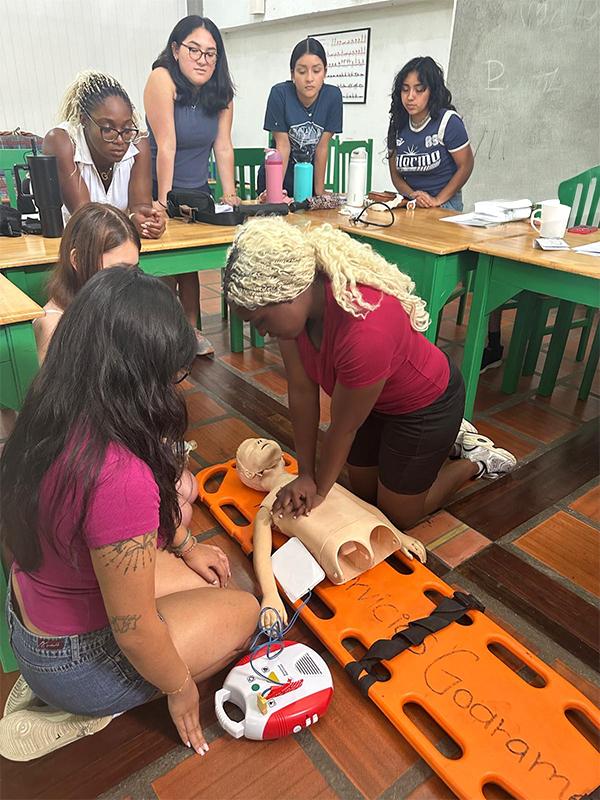
Programs like the “Engaging Global Health in Costa Rica” education abroad exemplify this commitment, offering students the opportunity to gain firsthand experience with global health systems.
This five-week summer immersion in Costa Rica combines academic coursework with cultural and clinical experiences. Participants enroll in two courses: “Global Health” and “Spanish for Health Care Professionals,” earning six credit hours.
Under the guidance of faculty members Ana Todd, PhD, RN, clinical associate professor, and Nancy Guillet, DNP, MD, MSN, RN, clinical assistant professor, students explore Costa Rica’s universal health care system, known for its emphasis on preventive care and accessibility.
Through site visits to community-based organizations and health care facilities, students gain firsthand insight into the country’s approach to health determinants and outcomes. Living with local host families further enriches the experience, fostering language proficiency and cultural understanding.
This program not only broadens students’ global health perspectives but also equips them with the skills to advocate for equitable health care practices upon their return.
The School of Nursing also has a partnership with Moi University in Kenya, through the Academic Model Providing Access to Healthcare consortium.
This collaboration encompasses a range of initiatives, including faculty-led research, student exchanges and joint clinical projects aimed at enhancing health care delivery in both regions.
In July 2023, a team of UT Austin students and faculty traveled to Kenya to work alongside Moi University counterparts on wound care prevention and treatment strategies.
Their efforts included developing locally sourced medical devices, creating educational materials in English and Swahili and conducting qualitative studies on barriers to effective wound care.
Global Growth
Kim will leverage the School’s standing as an international leader in nursing research to strengthen the Center’s impact on global health.
She envisions the CGNH evolving into a dynamic hub of innovation and collaboration in global nursing and health. Her goal is to expand the Center’s reach, enhance its research portfolio and create more opportunities for both students and faculty to engage in impactful global health initiatives.
Under her leadership, the CGNH will prioritize sustainable partnerships and evidence-based interventions that tackle the most pressing global health challenges, with a focus on making a tangible difference in communities across the globe.
“Joining the faculty at the School of Nursing and leading the CGNH is a tremendous opportunity to work with talented colleagues and students who are passionate about making a difference in the world,” Kim concluded. “I am excited to contribute to the School’s legacy of excellence and to help shape the future of global nursing and health.”